
Data Engineer Things Newsletter - Community Spotlight Edition (Dec 2025)
From big tech to independent consulting: the art of professional brand building and communication. Featuring Ben Rogojan (aka the Seattle Data Guy).


Hi everyone,
I’m excited to launch our new Community Spotlight series! Alongside our classic Data Pulse edition, this format focuses entirely on deep-dive interviews. We have one rule for these: they must offer actionable learnings.
So, grab your favorite warm drink and meet our first guest: Ben Rogojan, aka the Seattle Data Guy! From leaving Facebook to building an independent empire, Ben breaks down how he grew a following of 100k+ and why communication often beats coding.
One thing Ben mentions really stood out to me: “You can get a lot of scale through content, but it’s hard to beat in-person relationships.”
I recently returned from AWS re:Invent in Las Vegas, and I can absolutely confirm that. It was wonderful to meet so many people there, but now it’s time to slow down 🎄.
Let’s dive in!
- Volker
Spotlight: Ben Rogojan (Seattle Data Guy)
“You don’t have to learn or be everything at once. Wherever your journey is now, enjoy it. You never know when it’ll shift.”
Please introduce yourself briefly to the Data Engineer Things community and share how you’ve built your personal brand to reach over 100,000 followers.
Hello! My name is Ben Rogojan, I’ve been working in the data world for over a decade now. I started as an analyst and then found data engineering when I was looking for a role that matched the skills I enjoyed over title. While I was working full-time I had a few people ask me to help on some side projects so I started the Seattle Data Guy brand as a consulting company but I very quickly realized I needed to find a way to get myself known. So I started writing content I wish I had more of when I started.
If your journey from corporate data engineer to successful consultant and content creator was a Git repository, what would be the commit message for where you are right now? And what was the most significant “merge conflict” you had to resolve along the way?
I think the commit message would say something like “breaking out and trying new things” or “pattern interrupt phase”. I’ve been spending a lot of time trying to figure out how to shake up my thinking and habits. I’ve been consulting for a few years and it can be tempting to fall into the same habits. So I have been looking for places where I can challenge my habits.
For merge conflicts, I think one that sticks out was when I was making the decision to leave Facebook. I had spent so much time and effort getting a job there that it felt wrong. I had a consulting business that was growing but it was hard to rationalize the decision due to all the prior effort.
You made the transition from working at Facebook to running your own data consulting business. What were the most critical steps in that journey, and what would you do differently if you were starting over today?
I had been consulting off and on through most of my career. The first project I did was actually helping a client move from Access to SQL Server and now its a lot of SQL Server to cloud migration projects.
The most critical step for any consultant is figuring out how you will land clients. Some people are good at marketing, others sales motions, still others are great at networking in person. I think in terms of what I would have done differently is I would have put more effort into meeting more people in person and building relationships.
I believe that’s even more true now than it was in the past. You can get a lot of scale through content, but it’s hard to beat in person relationships.
“By the end of the first year I had already made a more than working at Facebook and since then my total take home has grown comfortably.”
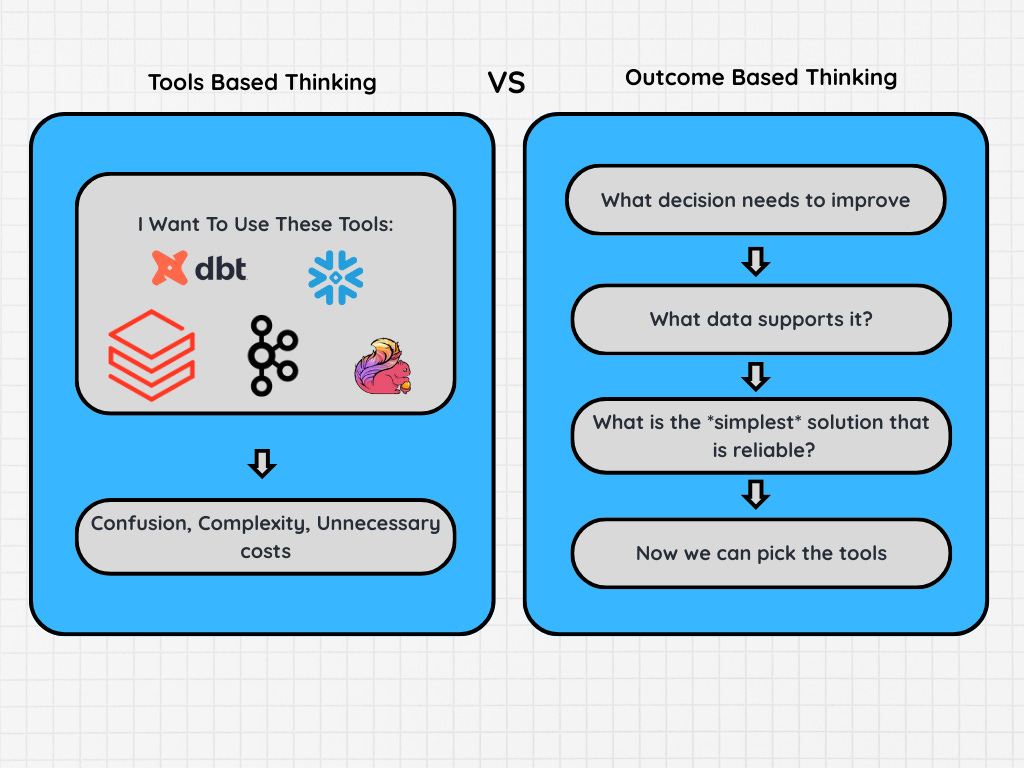
Your LinkedIn profile states you’re “Tool-Agnostic, Outcome-Obsessed”. How did you develop this clear value statement, and how has it helped you attract the right clients for your consulting business?
I think it can be tempting to prescribe a prior solution to every client. Also, I’ve come across many clients whose data stacks have gotten decently chaotic due to the fact that a consultant decided to add their preferred stack on top of what already exists.
Instead, I aim to come into all my projects by understanding the companies business needs first, their technical talent, budget, and so forth. From there I look for the tools that meet the companies’ needs. In some cases buying a solution can prove far faster and easier on a company with limited data resources and in others the company’s goal is to make data a major part of their offering and the overhead of adding more data per customer would be too expensive for an out of the box solution.
Your newsletter and YouTube channel have both reached over 100,000 subscribers. What content strategy has been most effective for growing your audience, and how do you balance creating content with client work?
I’ve tried multiple times to create and follow a content strategy and calendar. But I always tend to drift.
So my approach is to find 2-4 themes I enjoy at the moment based on the problems I am either experiencing with recent clients, or discussing with data leaders and create content around that. I find that there are trends in problems so if you keep experiencing a similar problem, it’s likely there are plenty more people dealing with it.
If you had to start over today with zero followers across all platforms, which single platform would you focus on first, and what specific content format would you prioritize to build your audience most efficiently as a beginner?
I think writing is always the easiest place to start. Start sharing your ideas on a platform like Substack (as long as it stays friendly to email) or if you aren’t wanting to write long articles then consider a platform like LinkedIn. I don’t think there is a best place. Early on, I believe you’re focused on finding your voice. So having a large audience isn’t the goal. You’re trying to learn, figure out what type of content you enjoy, etc. Overall, good content gets noticed.
Many professionals struggle to grow their audience while maintaining focus on their core business. What’s your framework for deciding which content to create, and how do you balance creating content that attracts followers versus content that converts followers into clients?
Early on I was mostly focused on creating content that I enjoyed and felt like needed to be covered. Since then I’ve started to create a mix of both content for new data engineers as well as for possible clients.
I think this is an area I could generally improve. I don’t spend a lot of time on a content plan with clear ratios of content x and y. Instead, I write what I want to write about.
For data professionals considering consulting, what has been your most effective approach for finding and securing new clients, and how has this evolved as your brand has grown?
I’ve spoken with dozens of consultants from both technical and non-technical backgrounds and the most common way most of them land clients is through their network. I know that can seem hard as if you’re just starting out as a data engineer or analyst as you’ve likely got a small network. But there are plenty of ways to grow it.
Working, going to events, looking for chances to give whether it be sharing content, working on open source projects, etc.
I’d also add that you don’t need to find large projects first. There are plenty of projects out there where people need help automating an Excel report or some other task that you might think is small but you’ll learn a lot from (I did plenty of those projects).
What are the two most impactful actions data professionals can take today to start building their personal brand, even if they’re currently employed full-time?
We are all building our brand everyday. That doesn’t have to mean posting on LinkedIn, YouTube or Twitter.
So I’d say first, build a reputation at your job as the person that gets things done well. Be willing to take on hard problems. That’s how I started consulting as well, at a job a director who was a consultant and turning around a team learned that I was technical through the grape vine and he reached out asking if I wanted to help on a project.
Second, if you do want to do content, create content that you wished you’d had when you started.
How important are communication skills versus technical skills for data professionals today, and what are the three most impactful lessons you’ve learned?
Learning how to communicate seems to be a forever lesson for me. I am always speaking with people who are better and conveying ideas, getting buy-in, teaching and other skills that require different forms of communication.
Technical skills are always important. I really enjoy Alex Ewerlöf’s diagram of skills for making sure that’s not skipped. In terms of lessons:
Think about who you are communicating and tailor the message for them - It’s temping to get frustrated when you explain something you think should be simple to understand but the other party doesn’t seem to get it. I view this as my failure to understand my audience instead of their failure to understand.
Images work - Even an image that isn’t perfect is more likely to keep your reader engaged. It also makes it far easier to explain concepts like your internal network map of your various servers so that new employees can quickly get up to speed or if you’re trying to get buy-in for a dashboard having a mock-up makes the end state all the more real. Don’t just write when you can draw or diagram.
Cut out fluff - I tend to lean on the fluffy side of writing. I ramble., sometimes add sections purely for self indulgence. But when I reread it, I realize that what I’ve written adds very little to the overall piece. So cut it out.
What’s your vision for the future of independent data professionals, and what emerging opportunities should they be positioning themselves for?
I think data problems will continue to grow for a few reasons.
I believe businesses will continue to demand more and more from their data.
For some businesses that will mean more granular or complex data like images and unstructured data.
For others it’ll be integrating data sets that have never been connected.
But still for others it’ll just be answering key questions about the business. I think many people would be surprised how many businesses and organizations are early in their data journey or perhaps needing to revamp it. I like to say that many companies are in different data decades. So there will continue to be plenty of work for the next few years.
What’s one message you’d like to share with the Data Engineer Things community?
You don’t have to learn or be everything at once. Wherever your journey is now, enjoy it. You never know when it’ll shift. I didn’t know that the last day I was going to enter Facebooks offices was in March 2020. I kept assuming I’d be able to go back. Then it was gone.
And one day I am sure I’ll have my last consulting client.
I’ll put out my last YouTube video.
So enjoy being in whatever stage you’re at.
If you’re learning, learn! Dive deep, don’t worry about what other people are doing.
If you’re executing, execute to the best of your ability.
If you’re raising a family, do that. Be in that moment, because it’ll end and you’ll miss it.
Connect with Ben
Community poll
🎄
The Data Engineer Things team wishes you Happy Holidays and a Happy New Year! We look forward to giving back to this community with even more deep-dive interviews, news, and resources in the coming year.
ℹ️ About Data Engineer Things
Data Engineer Things (DET) is a global community built by data engineers for data engineers. Subscribe to the newsletter and follow us on LinkedIn to gain access to exclusive learning resources and networking opportunities, including articles, webinars, meetups, conferences, mentorship, and much more.
The insight about in-person relationships beating content scale is underrated in the LinkedIn optimization era. Ben's point about tailoring communication to the audience rather than blaming them for not understanding is a gamechanger for technical folks. I've seen so many engineers nail the tech but tank stakeholder buy-in because they treat communication as optional. The outcome-obsessed vs tool-agnostic framework makes alot of sense when you realize most data stacks are bloated from consultant pet projects.
Good article. I enjoyed reading. Thanks for posting.